Lakuwahi Project
Overview
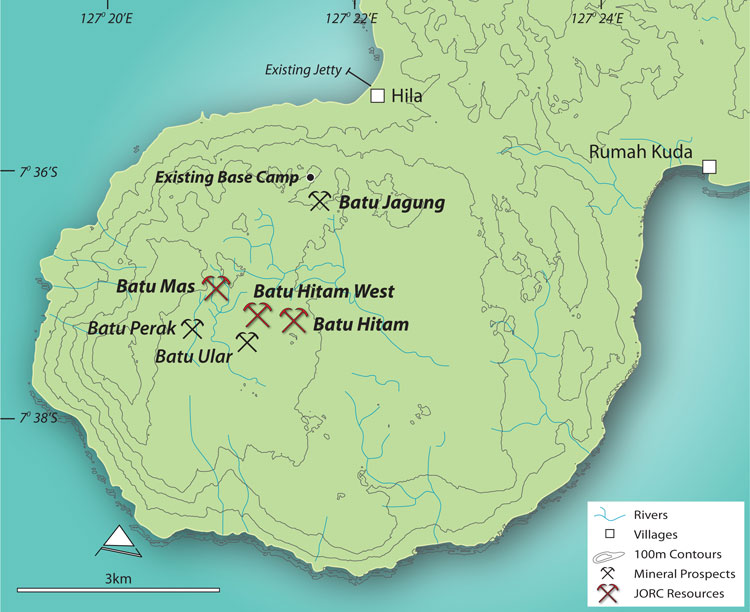
The Lakuwahi volcanic centre is the relic of the southern-most of two extinct volcanos that form Romang Island. This sub-sea volcano erupted rocks of andesitic composition, which is normal for a volcano situated along the Sunda-Banda magmatic arc. The plate-tectonic collision of the Australian plate with the Banda arc caused the simultaneous cessation of volcanic activity and rapid uplift of the volcano to near sea level. During the uplift the remnant heat in the dying volcano drove a large system of gold, silver and base-metal-bearing hydrothermal fluids, which altered and mineralised the rocks in the Lakuwahi volcanic centre. Coral reefs formed at shallow sea depths as the volcano was being up-lifted. Hydrothermal activity occurred episodically which probably killed the coral and partially mineralised the coralline limestone beds. The Lakuwahi Project hosts a large 6km by 4km zone of "Magnetite Destruction Zone" (MDZ), where to date, Robust has focused on three prospects found within it: Batu Mas, Batu Hitam, and Batu Jagung.
Further uplift to present-day elevations coincided with a cooling of the hydrothermal system - although there is evidence of minor fumarolic activity and associated native sulphur deposition occurring even now.
Robust currently has a total of 7 owner-operated diamond drill rigs actively exploring the Lakuwahi Project conducting exploration drilling designed to test fresh targets, as well as follow up extensions to the known mineral deposits.
Development Studies
On-going metallurgical testwork has provided the Company with further encouragement for near-term development of the Lakuwahi Project's oxide gold-silver resources with recent study results supporting the potential for a low CAPEX heap-leach operation.
Cyanide leach bottle roll testing on coarsely crushed oxide ore has demonstrated good leach kinetics and above average metal recoveries. On all coarse samples crushed to 8mm tested so far gold recoveries have averaged 77%, and silver 41% with recoveries still rising after 250 hours. Final recoveries are expected to go higher for both minerals and this will be determined from extended column tests.
Metallurgical samples from the Lakuwahi polymetallic sulphide project have also provided the company with encouraging results in recent heavy media tests carried out by ALS Laboratories in Tasmania. By crushing representative sulphide ore to an average of 3mm, heavy media (gravity) separation tests have shown upgrading of economic metals at good recoveries. On average metal values upgraded from 2 to 4 times feed grade at high recoveries into 37% of the original mass. (For further detail please refer to the Robust Resources ASX announcement 13 March 2012).
The proposed beneficiation, by fine crushing and gravity, can potentially reduce CAPEX and OPEX by treating a reduced volume of ore at lower chemical and energy consumption requirements, achieving lower wear factors from the silica rejection at the beneficiation stage and is environmentally cleaner. More testwork to establish the final beneficiation characteristics will be undertaken by Robust.