Indonesia
Lakuwahi Project
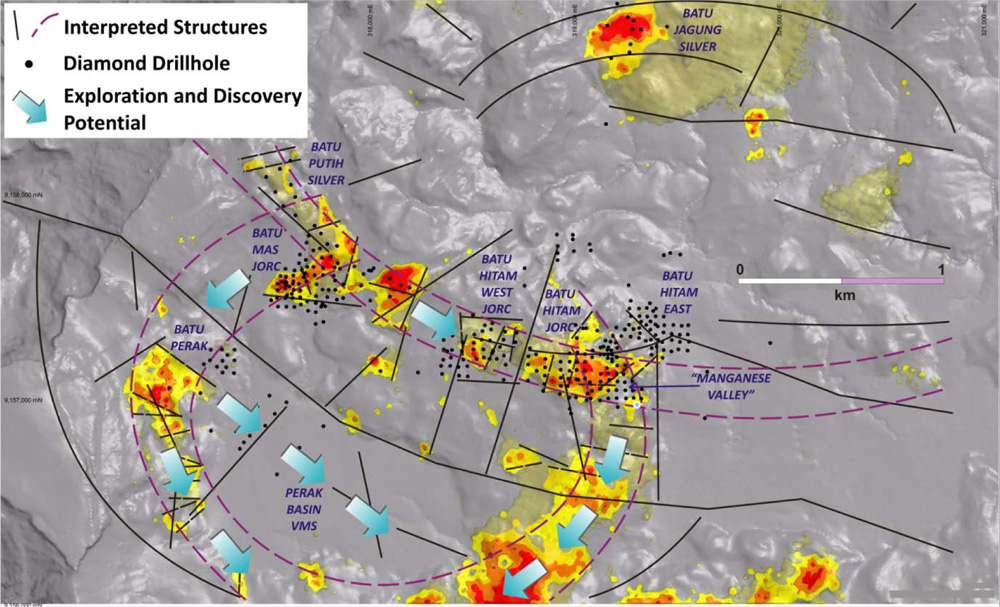
Robust has made significant discoveries of precious metals (gold and silver), base metals (lead, zinc and copper) and high-grade manganese throughout a 7-year exploration program of over 550 diamond drill holes and major geophysical surveys (IP, Resistivity, Magnetic).
Early exploration at Lakuwahi targeted near-surface, supergene enriched, gold-silver mineralisation. Heap leach gold operations together with a manganese Direct Shipping Ore mine were investigated as the probable first mining operations.
Polymetallic Deposit
In January 2012, Robust announced an initial Mineral Resource of 45.3 Mt with 592,000 ozs gold, 27.7 Mozs silver and base metals (compliant with JORC 2004 code).
However, discovery of high-grade Volcanogenic Massive Sulphide (VMS)-style polymetallic mineralisation beneath shallow cover sediments in the Perak Basin in late 2012 significantly changed the focus of exploration and direction of project development from a heap leach gold-silver operation to a larger, flotation, polymetallic project with significant base metal concentrations in addition to gold and silver.
Similarities exist to VMS mineralisation on nearby Wetar island, mined by Billiton in the late 1990s with over 17 tonnes (547,000oz) of gold produced. Mining has now recommenced on Wetar with extraction of copper from sulphide ores.
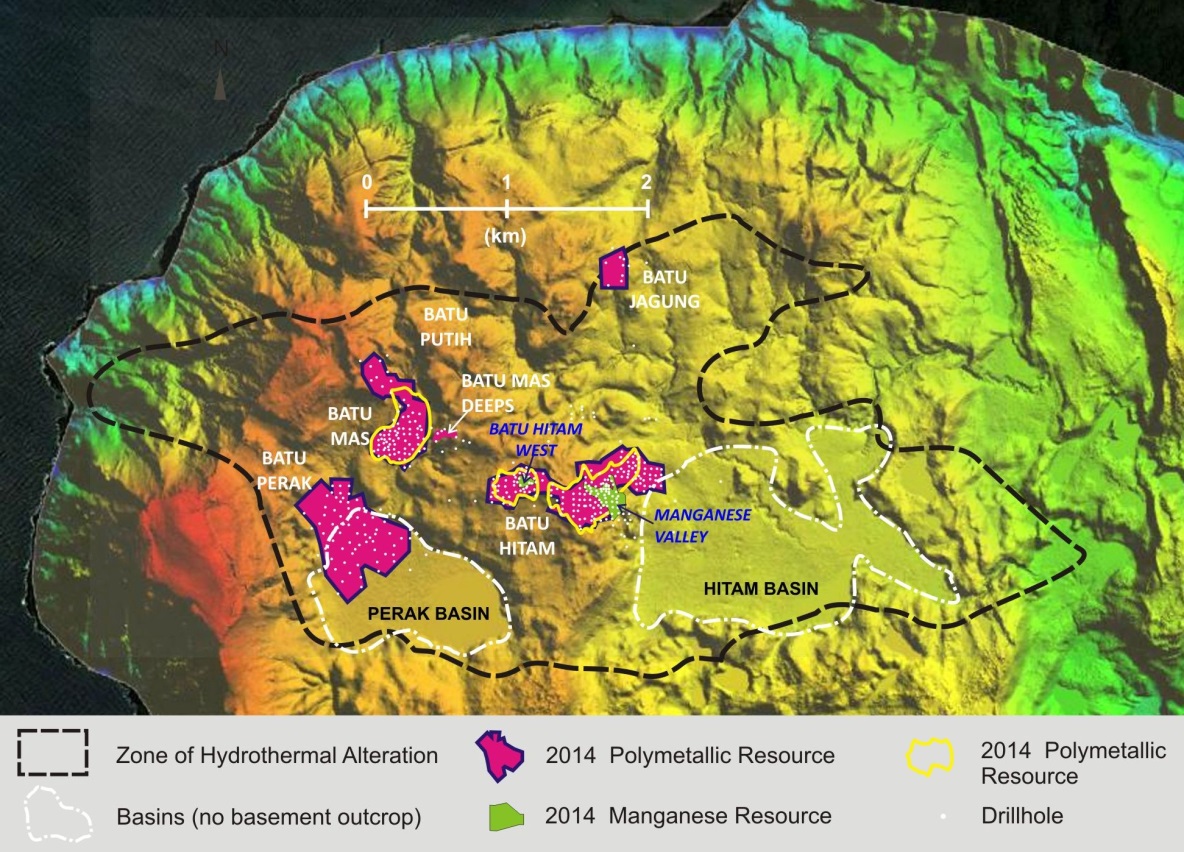
In July 2014, Robust Resources announced an updated JORC Mineral Resources (compliant with JORC 2012 code) for the Lakuwahi Polymetallic Deposit of 81.7 Mt- an increase of 80% tonnage from the initial resource announced in 2012.
Importantly, the 80% increase in tonnage was accompanied by;
- an increase in grade of combined precious metals (Au+Ag) of almost 15% from 0.74 g/t (AuAg)1 to 0.84 g/t (AuAg), resulting in
- a 107% increase in the precious metal budget from 1.07 Mozs (AuAg) to 2.21 Mozs (AuAg = 1.04Mozs Au + 67.9Mozs Ag).
| Class | Mass Mt | Au g/t | Ag g/t | Cu % |
Pb % |
Zn % |
Au Moz | Ag Moz | Cu Mlb | Pb Mlb | Zn Mlb |
|---|---|---|---|---|---|---|---|---|---|---|---|
| Inferred | 28.4 | 0.48 | 18.2 | 0.11 | 0.68 | 0.76 | 0.43 | 16.7 | 54 | 324 | 360 |
| Indicated | 16.9 | 0.29 | 20.3 | 0.13 | 1.20 | 1.03 | 0.16 | 11.0 | 41 | 374 | 318 |
| Total | 45.3 | 0.41 | 19.0 | 0.12 | 0.89 | 0.86 | 0.59 | 27.7 | 95 | 697 | 678 |
Initial Mineral Resources as at January 2012 (JORC 2004 compliant)
| Class | Mass Mt | Au g/t | Ag g/t | Cu % |
Pb % |
Zn % |
Au Moz | Ag Moz | Cu Mlb | Pb Mlb | Zn Mlb |
|---|---|---|---|---|---|---|---|---|---|---|---|
| Inferred | 43.9 | 0.34 | 28.6 | 0.08 | 0.64 | 0.72 | 0.48 | 40.4 | 73 | 621 | 700 |
| Indicated | 37.7 | 0.46 | 22.7 | 0.07 | 0.50 | 0.46 | 0.56 | 27.5 | 56 | 419 | 386 |
| Total | 81.7 | 0.40 | 25.8 | 0.07 | 0.58 | 0.60 | 1.04 | 67.9 | 128 | 1,040 | 1,086 |
Updated Mineral Resources as at July 2014 (JORC 2012 compliant)
Polymetallic Deposits
The VMS mineralisation consists of a gently-dipping, stratiform barite-rich exhalative (BEX) layer with at least three underlying barite-rich feeder systems (BFS). The BEX horizon is significant as it often carries Au/Ag mineralisation at higher grades than underlying stockwork and feeder zones. It varies from less than 1m to more than 8m thick and is consistently present throughout Perak Basin.
Feeder zones (BFS) underlying the BEX vary from 30 -- 100m metres in width, extend for up to 200 metres below the BEX and have been traced for over 500 metres in strike length with one zone, the Western BFS, still open to the south.
Mineralisation underlying the Perak Basin has several factors advantageous to preliminary concepts of open pit mining:
- Stripping ratio -- due to the shallow and flat lying mineralisation, a possible mine stripping ratio of around 4:1 is implied from the ratio of overburden to mineralisation in drill intersections.
- Mining parameters -- the BEX horizon is preserved under a thin layer of mostly unconsolidated basin fill sediments. Mining could be by inexpensive free dig methods.
- Easy access to deeper ore -- once the flat-lying BEX horizon is mined it would allow easy access to sub-vertical BFS zones and potential high-grade massive sulphide lenses (similar to Batu Mas Deeps-see below).
There are other non-outcropping basins within the Lakuwahi alteration zone including one, Hitam Basin, which is nearly twice the size of Perak Basin. Geophysical data has shown similar resistivity response to that for the VMS mineralisation in Perak basin.
Hitam Basin is virtually untested with only 3 drillholes at the extreme western edge of the Basin, one of these holes intersected 3 zones of polymetallic mineralisation of potential economic significance. Robust feels there is potential to uncover another significant VMS system beneath Hitam Basin.
Mineralised zones remain open in all major prospects at Lakuwahi including Perak Basin, Batu Perak, Batu Hitam, Batu Putih, Batu Jagung and Batu Mas.
A significant discovery was made in 2013 -- Batu Mas Deeps. This is a zone of very high-grade base metal sulphide mineralisation underlying oxidised breccia-hosted mineralisation in Batu Mas. Intersections from drillhole LWD352 include;
- 17.0m at 25.67% combined base metals and 1.07 g/t AuEq from 175m
(0.86% Cu, 11.97% Pb, 12.84% Zn, 0.14 g/t Au, 49 g/t Ag) including: - 6.0m at 54.90% combined base metals and 1.78 g/t AuEq from 176m
(1.48% Cu, 26.02% Pb, 27.40% Zn, 0.16 g/t Au, 49 g/t Ag)
High-grade base metal intersections have been returned in all Lakuwahi prospects but with the exception of Batu Mas deeps have not been followed up yet. There is potential for discrete zones of high-grade base metals mineralisation within all the prospects which would be important to enhance the economics of the Lakuwahi project as a whole.
Robust considers that the 13km2 Lakuwahi hydrothermal alteration zone is still underexplored and represents significant potential to add to this world-class polymetallic deposit.
1 AuAg = (Au + Ag/58)